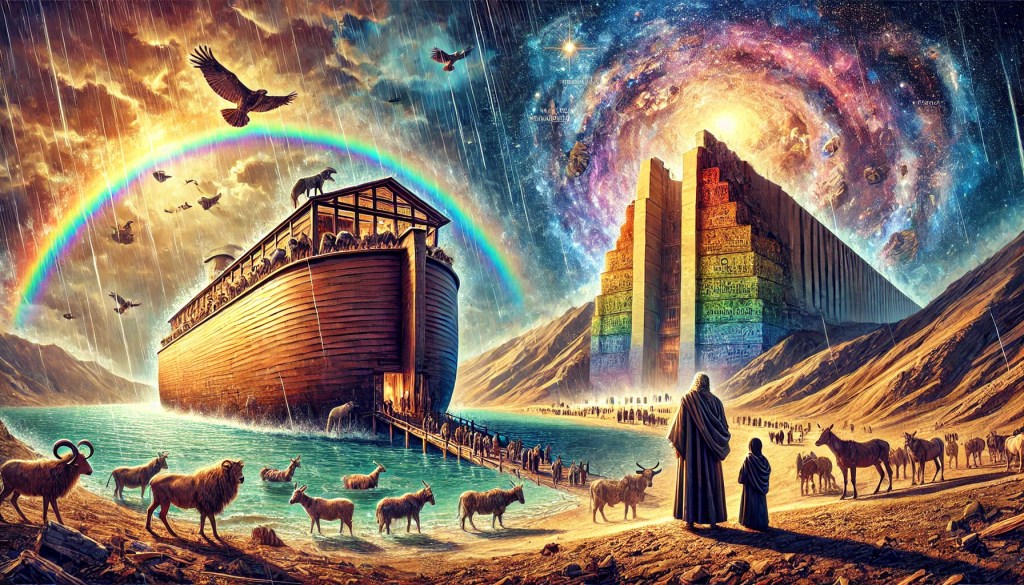
These passages from Genesis recount God’s disappointment with humanity’s wickedness. As a result, God resolves to cleanse the Earth with a great flood, sparing only Noah, his family, and pairs of animals. After the flood, God makes a covenant with Noah, promising never again to destroy all life with a flood, symbolized by the rainbow. The text then traces the lineage of Noah’s sons, describing the origins of different nations and languages, including the story of the Tower of Babel and its aftermath. The narrative shifts to the line of Shem, leading to Abram, whom God calls to leave his homeland and promises to make into a great nation. Abram’s journey to Canaan and his experiences in Egypt, including his deception regarding his wife Sarai, are also covered.
Subject: Analysis of key themes and ideas within Genesis 6-12, covering the narrative of the Flood, the covenant with Noah, the Tower of Babel, and the lineage leading to Abram and the call of Abram.
Purpose: To provide a concise overview of the major narratives and themes within Genesis 6-12.
Key Themes and Ideas:
- Wickedness and Divine Regret:
- The earth becomes corrupt, filled with violence and evil inclinations. “The Lord saw how great the wickedness of the human race had become on the earth, and that every inclination of the thoughts of the human heart was only evil all the time.” (6:5)
- God regrets creating humanity and resolves to wipe out all life. “The Lord regretted that he had made human beings on the earth, and his heart was deeply troubled. So the Lord said, “I will wipe from the face of the earth the human race I have created.” (6:6-7)
- The Nephilim are introduced, offspring of the “sons of God” and “daughters of humans”, depicted as heroes of old. “The Nephilim were on the earth in those days—and also afterward—when the sons of God went to the daughters of humans and had children by them. They were the heroes of old, men of renown.” (6:4)
- Noah’s Righteousness and Salvation:
- Noah is presented as a righteous man who finds favor in God’s eyes. “But Noah found favor in the eyes of the Lord…Noah was a righteous man, blameless among the people of his time, and he walked faithfully with God.” (6:8-9)
- God instructs Noah to build an ark to save his family and representatives of all living creatures from the impending flood. God establishes a covenant with Noah. “But I will establish my covenant with you, and you will enter the ark—you and your sons and your wife and your sons’ wives with you.” (6:18)
- Noah obeys God’s commands precisely. “Noah did everything just as God commanded him.” (6:22)
- The Flood and Renewal:
- The flood is a catastrophic event that destroys all life on earth except for Noah and those on the ark. “Every living thing on the face of the earth was wiped out; people and animals and the creatures that move along the ground and the birds were wiped from the earth.” (7:23)
- After the flood, God remembers Noah and causes the waters to recede. “But God remembered Noah and all the wild animals and the livestock that were with him in the ark, and he sent a wind over the earth, and the waters receded.” (8:1)
- Noah sends out birds to determine if the land is dry, eventually receiving an olive leaf as a sign.
- Noah offers sacrifices to God after leaving the ark. “Then Noah built an altar to the Lord and, taking some of all the clean animals and clean birds, he sacrificed burnt offerings on it.” (8:20)
- God’s Covenant with Noah (Post-Flood):
- God promises never to destroy all life with a flood again and establishes a covenant symbolized by the rainbow. “I establish my covenant with you: Never again will all life be destroyed by the waters of a flood; never again will there be a flood to destroy the earth.” (9:11)
- God blesses Noah and his sons, commanding them to be fruitful and multiply.
- Dietary laws are introduced, prohibiting the consumption of meat with blood.
- There is an emphasis on the sanctity of human life: “Whoever sheds human blood, by humans shall their blood be shed; for in the image of God has God made mankind.” (9:6)
- The Sons of Noah and the Curse of Canaan:
- Noah’s sons, Shem, Ham, and Japheth, repopulate the earth.
- Ham disrespects his father Noah, leading to a curse on his son Canaan. “Cursed be Canaan! The lowest of slaves will he be to his brothers.” (9:25) This incident introduces themes of lineage, sin, and its consequences.
- The Table of Nations:
- Chapter 10 presents a genealogy of Noah’s descendants, tracing the origins of various nations and languages.
- It divides humanity into three main groups based on Noah’s sons: Japhethites, Hamites, and Semites.
- Nimrod is introduced as a “mighty warrior” and “mighty hunter,” founder of a kingdom that includes Babylon and Nineveh.
- The Tower of Babel and the Scattering of Languages:
- Humanity, united by a single language, attempts to build a tower reaching to the heavens. “Come, let us build ourselves a city, with a tower that reaches to the heavens, so that we may make a name for ourselves; otherwise we will be scattered over the face of the whole earth.” (11:4)
- God views this as a challenge to his authority and confuses their language, scattering them across the earth. “Come, let us go down and confuse their language so they will not understand each other.” (11:7) This explains the origin of diverse languages and nations.
- Genealogy from Shem to Abram:
- Chapter 11 provides a genealogical lineage from Shem to Abram, establishing Abram’s place within the broader narrative.
- It shows the gradual decrease in lifespan from Shem to Abram’s ancestors.
- The Call of Abram:
- God commands Abram to leave his homeland and go to a land that God will show him. “Go from your country, your people and your father’s household to the land I will show you.” (12:1)
- God promises to make Abram into a great nation, bless him, and make his name great, with all peoples on earth being blessed through him. “I will make you into a great nation, and I will bless you; I will make your name great, and you will be a blessing.” (12:2)
- Abram obeys God’s command and sets out for Canaan.
- Abram in Egypt:
- Due to famine, Abram travels to Egypt.
- Fearing for his life due to Sarai’s beauty, Abram asks her to pretend to be his sister.
- Pharaoh takes Sarai into his palace and treats Abram well.
- God afflicts Pharaoh with diseases, leading to the discovery of Sarai’s true relationship to Abram and their expulsion from Egypt with wealth.
Conclusion:
Genesis 6-12 marks a pivotal section in the narrative, moving from widespread corruption and divine judgment to a new covenant with humanity. The story then transitions to focus on lineage and national origins, culminating in the calling of Abram, the father of a new nation and the beginning of a new phase in God’s relationship with humanity. The themes of sin, judgment, mercy, covenant, and divine purpose are all interwoven throughout these chapters.
Genesis 6-12: A Study Guide
I. Key Themes and Concepts
- The Nature of Sin and Wickedness: Explore the depiction of human corruption and its consequences. How does God respond to widespread evil?
- Divine Judgment and Mercy: Analyze the balance between God’s judgment of sin and His preservation of life through Noah.
- Covenant and Promise: Understand the significance of the covenant established with Noah and its implications for humanity and the earth.
- The Origin of Nations and Languages: Trace the genealogy of Noah’s descendants and the explanation for the diversity of languages.
- Human Ambition and Its Limits: Examine the story of the Tower of Babel and its commentary on human pride and divine intervention.
- The Call of Abram and the Beginning of a Nation: Study the significance of God’s call to Abram and the promises associated with his lineage.
- Faith and Deception: Consider Abram’s faith, and also his moments of deception and how God responds.
II. Quiz: Short Answer Questions
Answer each question in 2-3 sentences.
- Why does God decide to flood the earth in Genesis 6?
- What specific instructions does God give Noah regarding the ark?
- What is the significance of the dove returning with an olive leaf?
- What is the covenant that God establishes with Noah after the flood, and what is its sign?
- What act does Ham commit that leads to Noah’s curse upon Canaan?
- What is the purpose of the Table of Nations in Genesis 10?
- What motivates the people to build the Tower of Babel?
- How does God thwart the construction of the Tower of Babel?
- What does God promise Abram in Genesis 12?
- What does Abram ask Sarai to do in Egypt, and why?
IV. Essay Questions
- Discuss the portrayal of God in Genesis 6-9. How does this portrayal reflect both judgment and mercy?
- Analyze the significance of the covenant between God and Noah. What are the terms of the covenant, and what does it reveal about God’s relationship with humanity?
- Explore the themes of sin, punishment, and redemption in the stories of the flood and the Tower of Babel.
- Compare and contrast the characters of Noah and Abram. What qualities do they share, and how do they differ?
- Examine the role of genealogy in Genesis 10-11. How does the Table of Nations contribute to the narrative and the broader themes of Genesis?
V. Glossary of Key Terms
- Nephilim: Mysterious figures mentioned in Genesis 6:4, often interpreted as giants or offspring of “sons of God” and human women.
- Ark: The vessel built by Noah to save himself, his family, and animals from the flood.
- Covenant: A binding agreement or promise, often between God and humanity, establishing specific terms and obligations.
- Cubits: An ancient unit of measurement based on the length of the forearm, used to describe the dimensions of the ark.
- Table of Nations: A genealogy in Genesis 10 that traces the descendants of Noah’s sons and their distribution across the earth, forming the basis for different nations and languages.
- Babel: The city where the Tower of Babel was built, symbolizing human pride and rebellion against God.
- Shinar: An ancient region in Mesopotamia where both the Tower of Babel and some of Nimrod’s kingdom were located.
- Abram (later Abraham): A key figure in Genesis, chosen by God to be the father of a great nation and the recipient of divine promises.
- Sarai (later Sarah): Abram’s wife, who initially is unable to conceive but is later promised a son by God.
- Shem, Ham, Japheth: The three sons of Noah, from whom all the nations of the earth are descended after the flood.
 Bible-Journey.com
Leave a comment